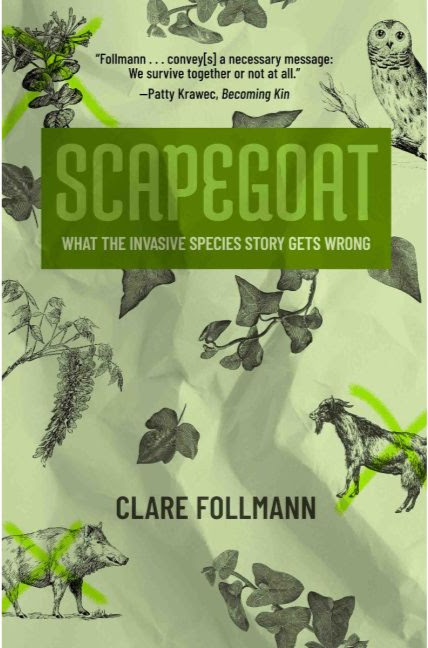
The problem with invasive species is a problem of capitalism.
A caste of plants and animals, labeled “invasive species,” are charged with being a key cause of habitat degradation that must be eradicated at any cost—an ethically questionable and often futile approach. While some invasive species cause great environmental damage, recent developments in the study of ecology have found that intervention efforts themselves have frequently proved more harmful than helpful to their local ecosystems. Yet the outdated narrative of “species management” persists in both public belief and conservation policy, distracting from and even justifying a far greater threat to biodiversity: the global capitalist system that is destroying our planet.
Drawing on environmental science and semiotics, Scapegoat recounts how the use of biased rhetoric and inaccessible language has created support for a popular but misleading war of “native” against “invasive” that does nothing to address the root cause of biodiversity loss. Instead, these are “plastic words” that lose their precise scientific origins with their introduction to everyday language yet still carry the weight of authority—becoming persuasive and dangerously malleable. In her surprising and clear-eyed polemic, Clare Follmann challenges the received wisdom on invasive species in light of the true ecological crisis we face. This book poses moral and political questions to make us rethink our relationship with nature (and each other) in a rapidly changing world.
Clare Follmann is a writer, activist, and gardener with a master’s in environmental science whose work engages with themes of landscape, ecology, climate crisis, language, and philosophy. She is located in Olympia, Washington, where she contributes to urban farming and botany initiatives.
Praise for Scapegoat:
“The stories we tell, and the language we use to tell them, matter deeply. Follmann offers another story, with thoughtful language and without romanticizing the relatives who expand beyond all good sense, to convey a necessary message: we survive together or not at all.”
—Patty Krawec, author of Becoming Kin
“Incisively thought-provoking and utterly enthralling—Scapegoat is a deeply researched history of how we talk about invasive species, which is to say how we talk about science, “bad” and “good,” our own role in the natural world, and the search for a better future. This book made me want to go to a dinner party because there were so many conversation I wanted to start after reading it.”
—Erica Berry, author of Wolfish
“Follmann takes us on a journey through language itself and then back out into the world, to see the ‘battle’ on our planet as not between species but between capitalism and all life on Earth.”
—Sarah Stein Lubrano, author of Don’t Talk About Politics
 Clare Follmann